
When a buyer asks about material handling, the answer usually comes back as a number. Ten-ton bridge crane. Five-ton bridge crane. Whatever the tag says.
It's a fair answer to the question. But it isn't an answer to the question underneath it, which is the one that matters: will my part be handled correctly, is it safe, and will it ship when you said it would?
Those questions aren't only about lift capacity. They're about the capacity at the point of work, at the moment the work needs to happen. Those are two different things, and the gap between them is where handling problems live.
The gap
We run a 30,600 square foot facility with reinforced floors and bridge crane coverage, built from the ground up for large, heavy workpieces. On paper, our overhead capacity is not a constraint. In practice, a bridge crane serves a footprint, and it serves one job at a time. When a crane is committed to setting a block on a large-format wire EDM, it is not available to the operator two bays over who needs to reposition a plate on a grinder.
That operator has options, and each one costs somebody something. Waiting for the crane is queue time on a job that was ready to run. Pulling in a second person is capacity taken from another job. Finding a fork truck with the right attachments and maneuvering it in a tight space is its own delay. The part gets moved either way. The job runs. The cost is invisible, but it's there.
Why weight is the wrong measure
There's a common assumption that manual handling is a weight question with a bright line: under some threshold it's fine, over it you need equipment. It's worth being precise here.
In the United States, OSHA does not publish a numeric lifting limit (here). There is no legal weight above which a lift requires a hoist and below which it doesn't. What exists instead is the NIOSH Lifting Equation (here), the framework most U.S. safety professionals actually use, and it treats weight as only one input among several — alongside reach, vertical travel, repetition, duration, how much the body has to twist, and how well the load can be gripped.
That's why a 40 pound casting can be a bigger problem than a 200 pound block. The block gets picked once, with a crane, by a person who knows it needs a crane. The casting gets picked forty times a shift, at arm's length, from an awkward angle, with no good place to put your hands. Weight alone will never flag it. The math, and the operator's lower back, will.
What we did about it
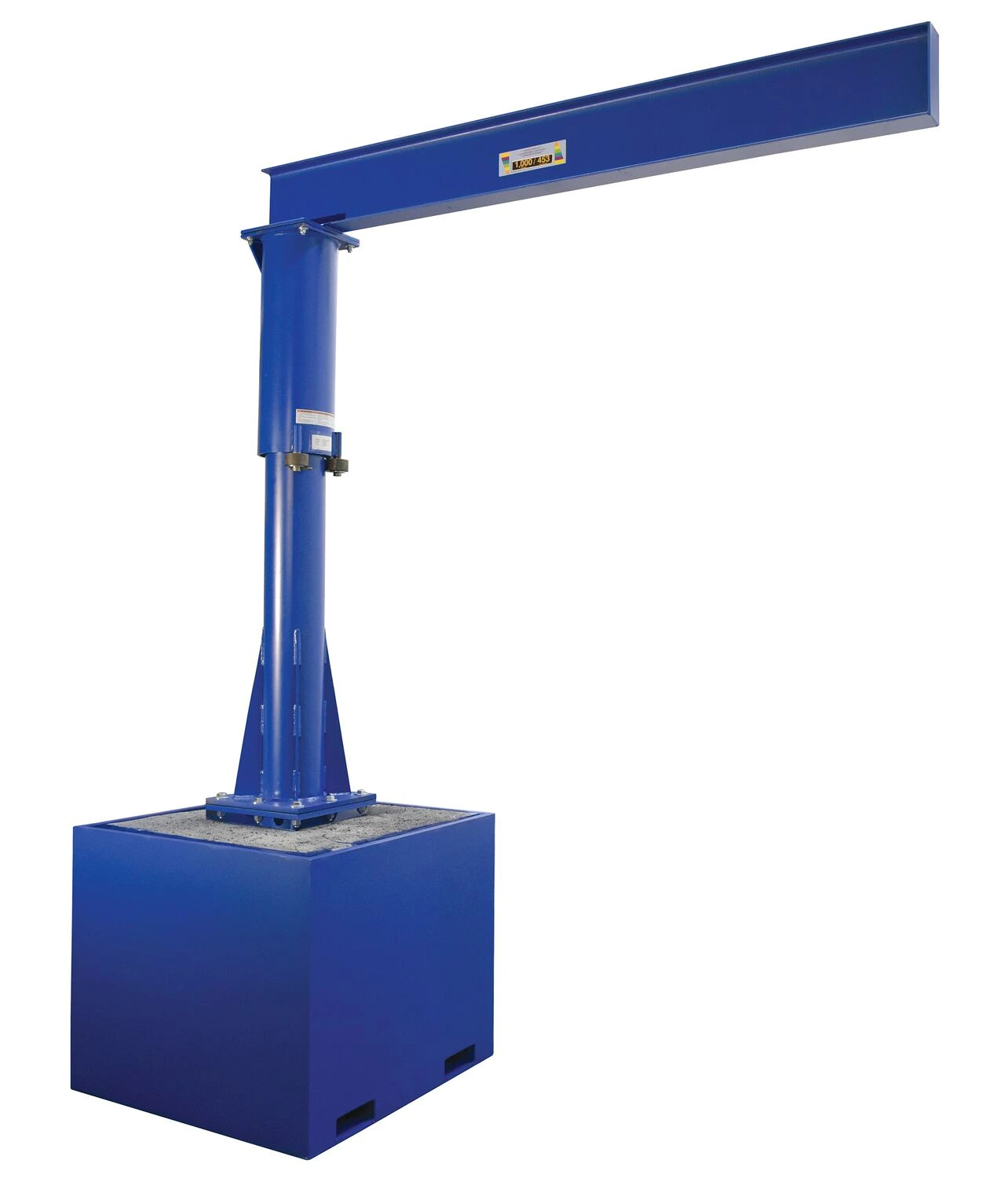
We heard about this from the floor — not as a complaint, but as a description of how certain jobs actually went. We added a half-ton portable jib crane with a chain hoist.
The specification is unremarkable. The critical term is portable. This unit isn't tied to a bay, a column, or a crane rail. It goes to the job. When a setup needs repeated repositioning, the hoist is at the setup. When the bridge cranes are committed elsewhere, the machine that isn't in the crane's path still has lift available.
It isn't a replacement for heavy overhead capacity and was never meant to be. It fills the space underneath the bridge cranes — loads too heavy, too frequent, or too awkward to be a good idea by hand, but too small or too inconveniently located to justify tying up a crane. That space is larger in most shops than people think, and it's almost entirely unmeasured, because the work in it gets done anyway.
What this means for your part
Safety is the first reason we bought it, and that would be a sufficient on its own; our values always come first. But safety isn't the only reason, others focus on our customer.
Finished surfaces
A load that is awkward for a person to handle is a load that gets set down harder than it should. Ground faces, datum features, and finished surfaces don't care whether the handling was compliant — they care whether it was controlled. A hoist is a precision instrument in the same sense a fixture is: it takes a step that would otherwise depend on how much reach someone had left at the end of a shift and makes it depend on a mechanism instead. Handling damage is one of the least sophisticated ways to lose a part that took forty hours of machining, and it is entirely preventable.
Schedule
Waiting for a crane or truck is queue time. It doesn't show up on a router and it doesn't show up in a quote, but it shows up in a lead time. Material handling bottlenecks are unglamorous and they never make it into a capabilities brochure, but they are one of the many small things that determine whether a shop hits a date. We would rather remove them than explain them.
The win is shared
We have overhead capacity. What we needed in a specific set of situations, was accessible capacity. Our people told us. We fixed it.
The alternative to a shop that raises problems isn't a shop with fewer problems — it's a shop where people quietly work around them, and workarounds are invisible by design. They show up eventually as inconsistency nobody can explain.
The thing that protects our operators is the same thing that protects your datum face and your delivery date. Not a tradeoff, and not charity — the same investment, doing both jobs at once. That doesn't only apply to lifting. It's just easier to photograph a crane.