
When a part comes back out of tolerance or a process produces inconsistent results, the natural instinct is to fix the immediate problem and move on. But treating symptoms without understanding root causes guarantees the same issue will resurface—often at the worst possible time.
Effective quality management requires systematic tools for identifying why problems occur, not just what went wrong. At Infinity EDM, we use two complementary approaches: the 5 Whys technique for straightforward issues and the Wishbone (Ishikawa or Fishbone) diagram for complex problems where multiple factors interact.
Example Problem:
A machined part consistently measures 0.003" over tolerance on a critical dimension.
The 5 Whys Method: Following the Chain
The 5 Whys is elegantly simple: start with a problem statement and ask "why?" five times, with each answer becoming the basis for the next question. The goal is to move past surface symptoms to identify the underlying cause.
Problem: Part dimension is 0.003" over tolerance
(1) Why? → The cutting tool isn't removing enough material
(2) Why? → Tool wear has exceeded acceptable limits
(3) Why? → Tool change interval was missed
(4) Why? → No alert system exists for tracking tool life
(5) Why? → Tool life monitoring wasn't included in the original process documentation
Root Cause: Process documentation lacks tool life tracking procedures
This linear progression works well when cause-and-effect relationships are direct. Once you identify the root cause, the corrective action becomes clear: add tool life monitoring to the process documentation and implement a tracking system.
The 5 Whys excels at drilling down through layers of causation, but it has limitations. It assumes a single primary cause and can miss problems where multiple factors contribute to the outcome.
The Wishbone Diagram: Mapping Complexity
When a "5 Whys" analysis starts circling back on itself or when you suspect multiple contributing factors, it's time to escalate to a Wishbone diagram. This structured brainstorming tool organizes potential causes into major categories, revealing how different factors might interact to produce the problem.
The standard categories are:
- Man (people)
- Machine (equipment/tools)
- Method (processes/procedures)
- Material (raw materials/inputs)
- Measurement (inspection/verification)
- Environment (conditions/context)
Let's revisit our tolerance problem using this framework:
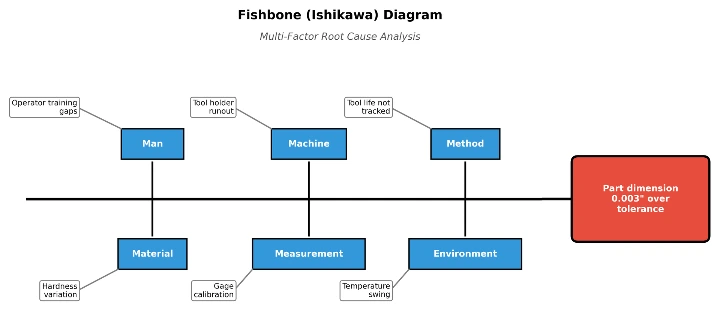
The Wishbone reveals that our tolerance issue might stem from machine condition, material variability, environmental factors, measurement technique, operator training, or inadequate procedures—potentially several of these working together. This comprehensive view prevents fixating on a single cause when the real issue involves multiple contributing factors.
Knowing When to Escalate
Start with 5 Whys for problems that appear straightforward. If you find yourself asking the same "why" in different ways, or if the chain keeps leading to different potential causes, that's your signal to escalate to a Wishbone analysis.
Use 5 Whys when:
- Cause-and-effect appears linear
- The problem seems to have a single primary root cause
- You need quick analysis for recurring similar issues
- The team agrees on the likely cause pathway
Escalate to Wishbone when:
- Multiple factors might be contributing
- 5 Whys produces circular or conflicting answers
- The problem is intermittent or inconsistent
- Cross-functional input would add value
- Previous corrective actions didn't prevent recurrence
The Wishbone takes more time and usually requires group input, but that investment pays off when dealing with complex problems. Trying to force a multi-factor issue through 5 Whys often leads to incomplete solutions that don't prevent the problem from returning.
The Payoff: Prevention Over Reaction
Both tools share the same purpose: moving from reactive firefighting to preventive quality management. Treating symptoms might get the immediate job out the door, but systematic root cause analysis prevents the next occurrence—and the one after that.
When a corrective action addresses the actual root cause rather than surface symptoms, you eliminate entire categories of future problems. That's the difference between a quality management system that adds value and one that just generates paperwork.
The choice between 5 Whys and Wishbone isn't about which tool is better—it's about matching the tool to the problem's complexity. Simple issues warrant simple tools. Complex problems require structured approaches that capture their full scope. Knowing when to escalate from one to the other is where systematic thinking becomes systematic improvement.
About Infinity EDM, LLC
Established in 1998 and located in Jackson, Wisconsin, Infinity EDM , LLC specializes in precision manufacturing services. For more information, visit www.infinityedm.com or call (262) 677-9473.