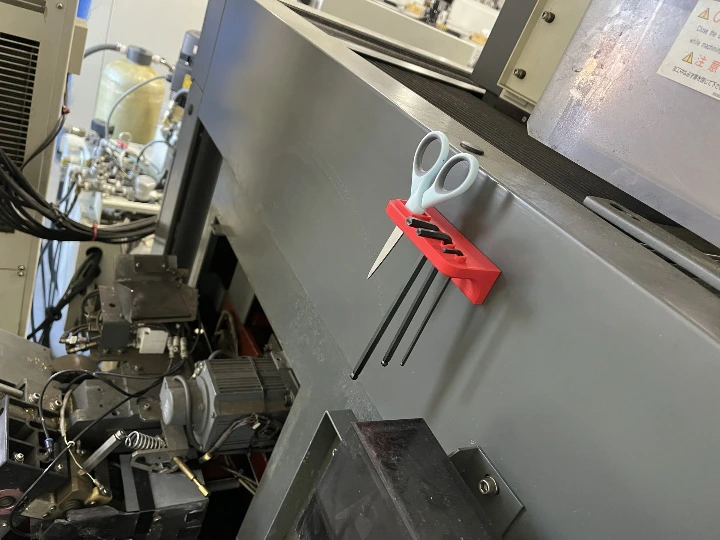
28 Brackets
There's a red 3D-printed bracket on the back of each of our wire machines. It holds a pair of scissors and three hex keys - the exact tools an operator needs to maintain the wire chopper assembly.
It's not complicated. We noticed our operators walking back and forth to the toolbox during routine maintenance. So we designed and printed 28 holders and mounted them where the work happens.
That's it. That's the whole story.
But We think there's something worth saying about what small things like this actually communicate.
What Small Things Say
In manufacturing, we talk a lot about respecting skilled trades. It shows up in mission statements and recruitment pitches. But respect isn't a statement - it's a pattern of decisions that people experience every day.
When an operator has to hunt for a 3mm hex key that should be within arm's reach, that's friction. It's not a crisis. Nobody's going to quit over it. But it sends a message: your time isn't valuable enough for us to solve this.
Multiply that by every small annoyance across a shift - the fixture that's awkward to reach, the paperwork that requires three steps when one would do, the consumable that's always running out - and you get a work environment that feels like it's fighting against the people doing the work.
The opposite is also true. When someone solves a problem before you have to ask, when the tools you need are where you need them, when the path between you and productive work is clear - that communicates something too. It says: we're paying attention, and we're trying to make your job easier.
The Math of Small Frustrations
This matters beyond morale. Manufacturing is a game of accumulated minutes.
A tool holder that saves 90 seconds per maintenance task doesn't sound like much. But choppers get maintained regularly. Across 28 machines, those seconds become hours, and hours become real money - either spent walking to toolboxes or spent cutting parts.
More importantly, when operators aren't interrupted by small frustrations, they stay in the flow of the work. They catch problems earlier. They maintain focus on the things that actually require their expertise and judgment.
The skilled trades shortage everyone talks about is real. But we've noticed that shops struggling to retain good people often have something in common: they treat operator inconvenience as a low priority. The message received is that the work matters but the worker doesn't.
Visible Results
None of this requires expensive solutions. A 3D-printed bracket costs a few dollars in filament and an hour of design time. The ROI is obvious - but more than that, it's visible. People notice when you fix things that affect their daily work.
We're not suggesting tool holders are transformational. We're suggesting that the accumulation of small, thoughtful improvements creates an environment where skilled people want to stay and do their best work. And that is transformational.
The best shops we've seen operate this way. They're not waiting for big capital projects to improve. They're relentlessly eliminating friction, one small fix at a time.
Those 28 brackets cost us a few dollars in filament and a weekend of printing. What they bought was a little less frustration and one more data point for our team that we're all paying attention to how the work actually gets done.